The last few years of AI-in-production have been mostly demos, excitement, and talk. For engineering leaders, that period is ending fast. Boards are no longer asking what production AI can do. They're asking what it has done, and whether it can be trusted to act without a human in the loop.
For AI agents to make the transition from triaging alerts and suggesting fixes to taking autonomous action in production, they need more than a capable model. They need to understand how your environment actually behaves, and they need governance that constrains what they're allowed to do in it. Without both, agents act on partial context. The same failures repeat, or worse: the agent's actions contribute to new ones. The trust required for autonomous action never gets built.
Here's the version I lived at Elastic Cloud: a senior SRE joins a 3am page, and within ten minutes she's reconstructed in her head what the new on-call has been staring at for the last two hours. Same telemetry. Two completely different understandings of what production is doing. The senior had the model; the dashboard never did. Now picture an AI agent in that scene, with even less context than the new on-call.
That's why we built the Context & Control Model for Production: to close production AI's blind spots, and to give engineering teams the governance layer that makes autonomous action in production safe to grant.
Agents are only as smart as the context they have
AI models can be brilliant reasoning engines, but they're probabilistic. Their reasoning comes from patterns learned from public data. They know generally what a Kubernetes pod is and how a microservice architecture works. But when it comes to your production environment, they have blind spots.
They don't know which of your services depend on which. They don't know that the payment service has a known sensitivity to the deployment pipeline introduced last quarter. They don't know what your on-call team learned at 3am six months ago, or that this exact failure pattern appeared before. That knowledge is proprietary, fragmented across logs, metrics, traces, tickets, dashboards, Git history, Slack threads, and the heads of your most experienced engineers. And they don't have a current view of how your production looks today: what significant events transpired, what changed yesterday, what deployed twenty minutes ago, what fired off as a result.
Without that deterministic foundation, no AI agent can be trusted to investigate correctly, let alone act autonomously. Production context has become a fundamental requirement for production AI.
Context Graph vs. Context & Control Model
A context graph (a structured record of how your production environment behaves, including the exceptions, overrides, and causal patterns that currently live in Slack threads and people's heads) is necessary. But it isn't sufficient.
Knowing what production looks like is only half the problem. The other half is what happens when an agent acts on that knowledge. Every action taken against production, whether by a human or an agent, has to be evaluated against the live model before it executes, bounded by what the team has defined as safe, and recorded in full. Compliance gets that audit trail for free. Trust is the actual goal.
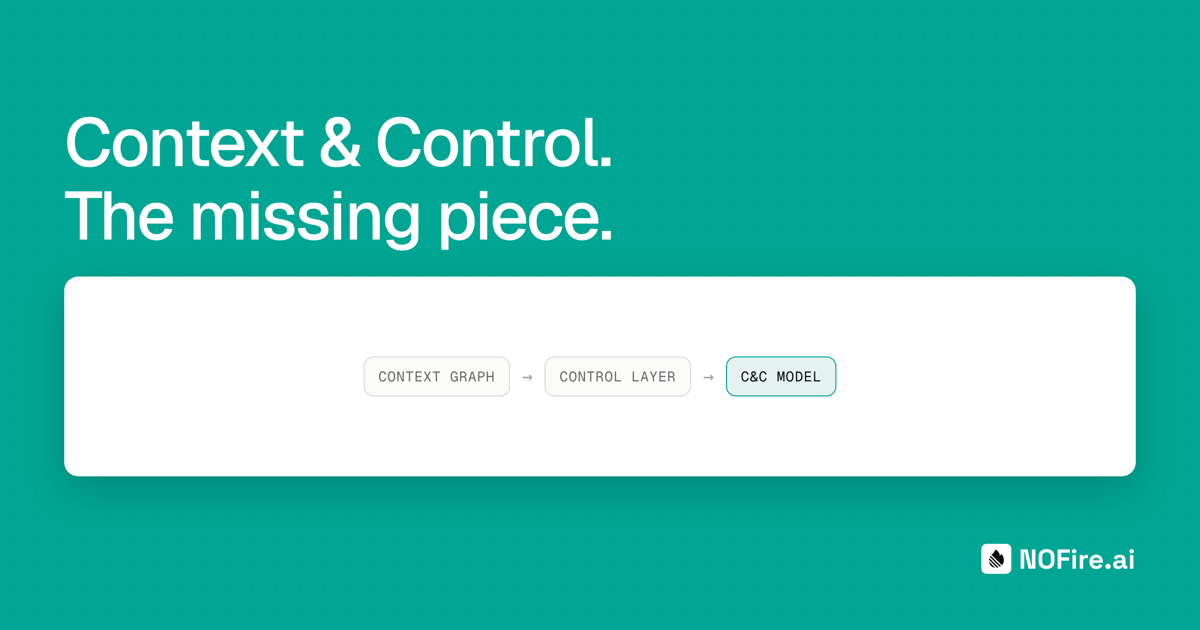
This is why a context graph alone isn't enough. You need a context & control model: the context that tells agents what production looks like, combined with the governance that defines what they're allowed to do inside it.
The Context & Control Model is the critical layer for production AI
The Context & Control Model brings together the ground truth and memory of a live production graph with the causal reasoning and governance required to act on it safely.
At its foundation is the Production Context Graph: a live, time-versioned map of every service, every dependency, every significant event, every deployment, every configuration change, and every failure pattern, reconstructable at any point in time. Every investigation deepens it. A team that starts with NOFire today inherits everything the system has already learned about their stack; a competitor showing up six months later starts from zero. That gap compounds.
The Context & Control Model gives production AI a foundation built to be:
-
Causal. It understands the sequence of changes, dependencies, and failures that make up how production actually breaks. Your agents know what happened, why, and through which dependency chain.
-
Stack-agnostic. It integrates across your entire infrastructure (Kubernetes, AWS, GCP, Azure, any telemetry stack), instead of being trapped in vendor-specific data silos. Your agents reason over a unified model of production rather than fragmented views.
-
Always live. It updates continuously, ingesting new deployments and configuration changes as they happen, and learning from every investigation in real time. The service deployed twenty minutes ago is already in the model, with no index cycle or staleness window.
-
Team-native. Learning accumulates at the team level, across sessions and handoffs. When an on-call engineer corrects a hypothesis at 2am, that correction survives. The system in month twelve knows a year of your team's incidents, patterns, and causal chains. A new engineer gets the same quality answer a senior SRE would. Knowledge that evaporates at the end of a session forces every investigation to start over.
-
Governed. Every action is evaluated against the live model before it executes, bounded by what your team has defined as safe, and recorded in full: what triggered it, what it evaluated, what ran, what it returned. Agents can act in production-critical areas because every action is auditable end-to-end.
With the Context & Control Model, engineering organizations get three tangible benefits:
-
Production AI your CFO can quantify. Every incident costs engineering time: senior engineers pulled from roadmap work, context reconstruction that takes hours, knowledge rebuilt from scratch at 3am. Every investigation anchored to pre-built production context removes that cost directly. The question is no longer whether production AI delivers ROI; it's whether your organization can afford to keep absorbing the cost of starting from zero on every incident.
-
Context that deepens over time. The model learns from every investigation and every correction. Every new agent investigation is cheaper and more accurate than the last. This is the only production infrastructure on your balance sheet that gets more valuable with every incident.
-
Context that survives your team. By encoding production knowledge in the model rather than in people's heads, your operational context survives team changes, reorganizations, and engineer departures. A new on-call engineer gets the same quality answer a ten-year veteran would.
NOFire AI is the trusted platform for production AI
With the Context & Control Model at its foundation, NOFire AI gives engineering teams end-to-end capabilities to prevent, resolve, learn from, and automate production operations, with governance over every action taken.
The platform connects to your existing observability stack: Datadog, Elastic, Grafana, Prometheus, PagerDuty, and more. It integrates with the AI models you already use. And it can run entirely in your environment, under your security controls, using models you already control via AWS Bedrock, Azure OpenAI, Google Vertex, or other self-hosted options. Data never leaves your environment.
This isn't a sudden idea for us. My co-founders and I have spent decades inside the parts of production that AI was always going to need.
I spent nine years at Elastic, the last several as a Distinguished Engineer responsible for the production readiness of Elastic Cloud. In that role I watched teams rebuild context from near-zero on every incident, even as I built observability products that, honestly, never fully closed that gap. Spiros led reliability and platform engineering at Mattermost and Lenses.io (acquired by Celonis), and wrote Argo CD in Practice because the GitOps tooling at the time needed that reference point. Tassos created urunc, the CNCF sandbox project sometimes described as "runc for unikernels". It's the execution-environment infrastructure that makes truly bounded autonomous action possible at the layer where actions execute.
The Context & Control Model for Production is what that combined experience made clear was always missing.
Teams have been trying to solve the knowledge retention and agent governance problem for years: through runbooks, postmortems, on-call documentation, and now AI tools that still start from scratch on every investigation. NOFire is the first system we know of that holds that knowledge permanently, deepens it continuously, and governs every action taken against it.
The Context & Control Model for Production is live at nofire.ai. If you'd like to see it on your stack, request a demo.