There's a gap forming in your engineering stack. And it's getting wider.
On one side: AI coding agents. Cursor, Claude Code, Copilot, and the LangGraph workflows your team is quietly running in the background. They write code. They open PRs. Some of them deploy.
On the other side: your production system. Dependencies mapped over years, incident patterns baked into specific services, deployments with blast radii that touch fifteen downstream teams.
The agents don't see that second side. They never have.
That's the gap.
What Agents See vs. What Production Knows
When a coding agent helps you refactor the authentication middleware, it has access to your codebase. It understands the code. What it doesn't have is production context:
- That this service had 7 incidents in the last 90 days
- That a change here affects 12 downstream services
- That the last time someone modified this file, checkout went down for 40 minutes
That knowledge lives somewhere: in your monitoring system, your incident records, your dependency graph. But agents can't reach it. So they make decisions without it.
This isn't a hypothetical risk. It's already happening. Agents are suggesting changes to high-blast-radius services without flagging the risk. They're recommending deploys on services with a history of regressions. They're missing context that any experienced SRE would have surfaced in the first five minutes.
Why MCP Changes This
Model Context Protocol (MCP) is a standard for giving AI agents access to external tools and data. Think of it like USB-C for AI: one protocol, many connectors.
The interesting thing about MCP isn't the protocol itself. It's what it makes possible: an agent that can reason about your production system, not just your codebase.
We built the NOFire MCP app to do exactly that. It ships as a native MCP integration: install it in Claude Code, Cursor, or any MCP-compatible agent in minutes, with no infrastructure to manage.
What the NOFire MCP App Does
Once connected, your agent gains access to nine production intelligence tools:
Entity discovery
nofire_search_entities: find services, pods, deployments by name in the NOFire entity graph.
Change intelligence
nofire_get_entity_changes: what changed on a service in the last N hours, with correlated VCS events (PRs, commits, authors).
nofire_get_recent_deploys: full cluster-wide deploy timeline with infra changes and VCS events in one view.
Risk assessment
nofire_assess_deployment_risk: deployment risk score (0-100) with weighted factors including incident history, blast radius, structural criticality, and change frequency.
nofire_analyze_blast_radius: how many services fail if this one goes down, by hop depth, with critical services flagged.
Dependency mapping
nofire_get_entity_dependencies: upstream and downstream service relationships.
Observability context
nofire_get_entity_metrics: available Prometheus metrics with ready-to-use PromQL queries.
Incident history
nofire_find_related_incidents: past incidents with root cause analysis, confidence scores, and recurring patterns.
Situational awareness
nofire_get_cluster_summary: cluster health signal, hot entities, and recent alert investigations in one call.
What This Looks Like in Practice
Here's a real example. You're in Claude Code, refactoring frontend-proxy before a deploy. You ask your agent: "Is it safe to deploy this change?"
Without NOFire, the agent looks at the code and makes its best guess.
With the NOFire MCP app connected, the agent calls nofire_analyze_blast_radius:
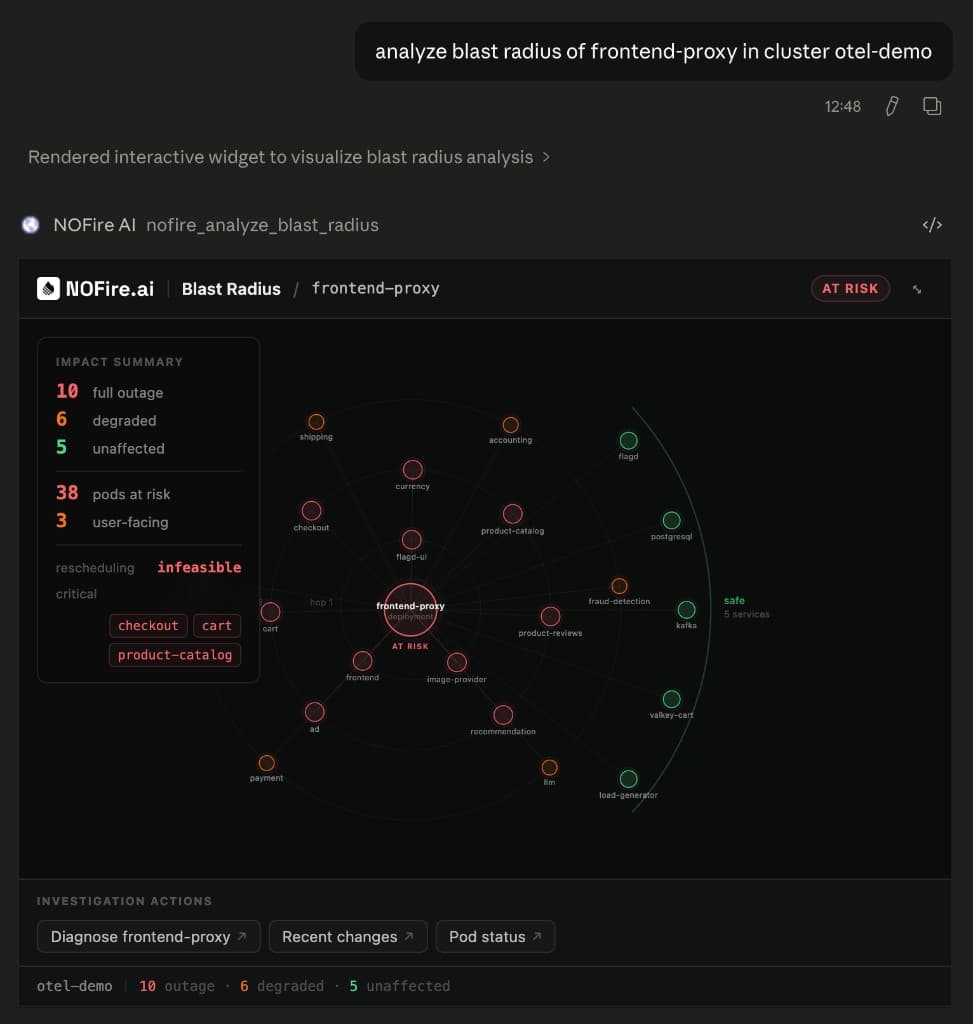
The agent now knows: this isn't a routine deploy. Checkout, cart, and product-catalog are in the blast radius. 38 pods at risk. Three user-facing services. The right call is to flag this before merging, not after the incident.
That's the difference between an agent operating blind and an agent operating with production context.
The Bigger Picture
We're at an inflection point. AI agents are moving from "helps you write code" to "participates in shipping code." The teams that get this right will have agents that flag risk before it becomes an incident. The teams that don't will debug the consequences.
Production safety isn't just a human responsibility anymore. Agents need it too.
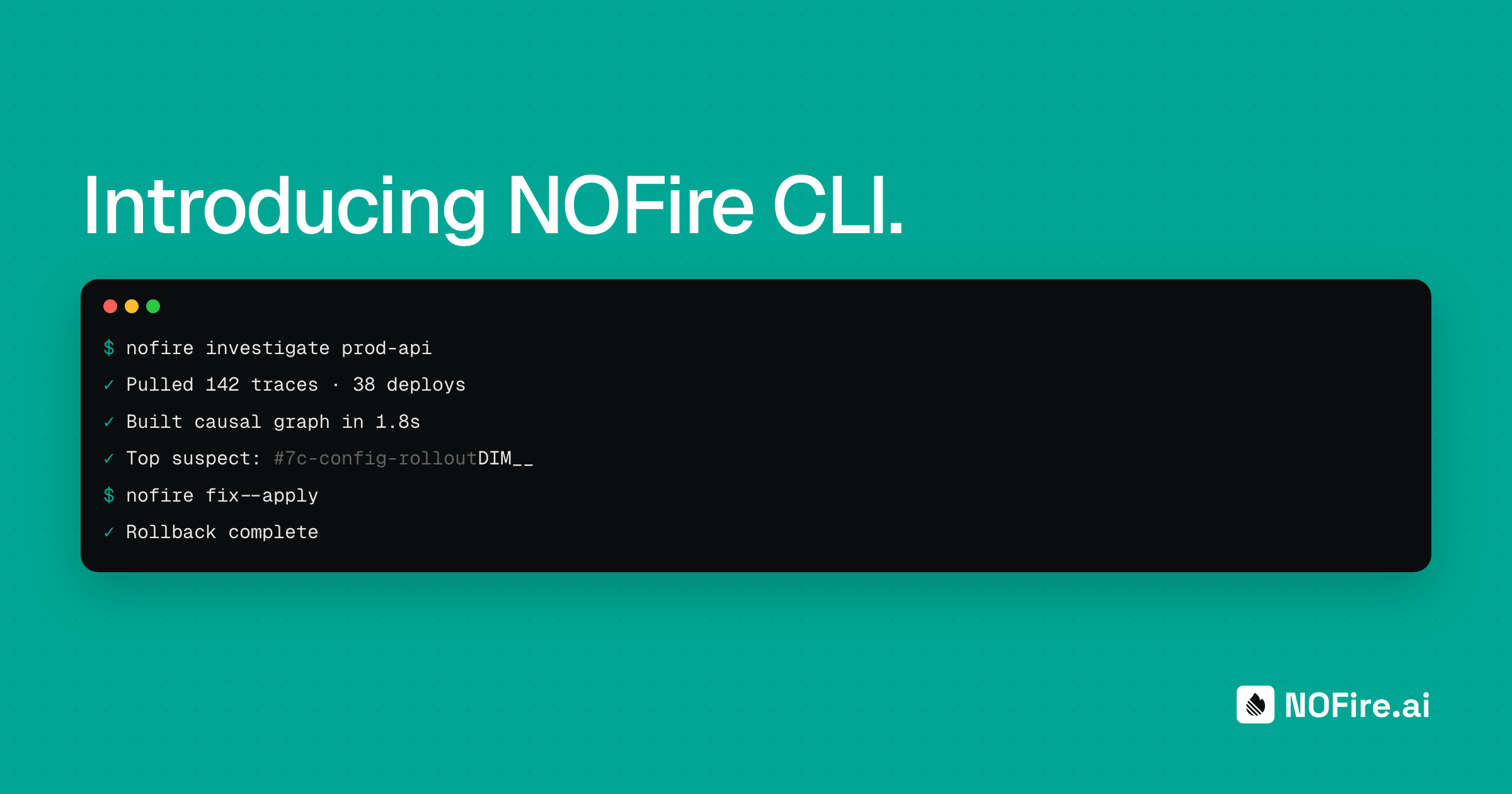
We brought NOFire to the terminal with our CLI. Now we're bringing it to your IDE.
The NOFire MCP app is available now for all NOFire customers. Install it directly in Claude Code or Cursor in under five minutes. One URL, one token, and your agent has production context.
Full documentation here.
Want to see what your coding agent is missing about your production system? Book a demo and we'll connect NOFire to your stack.