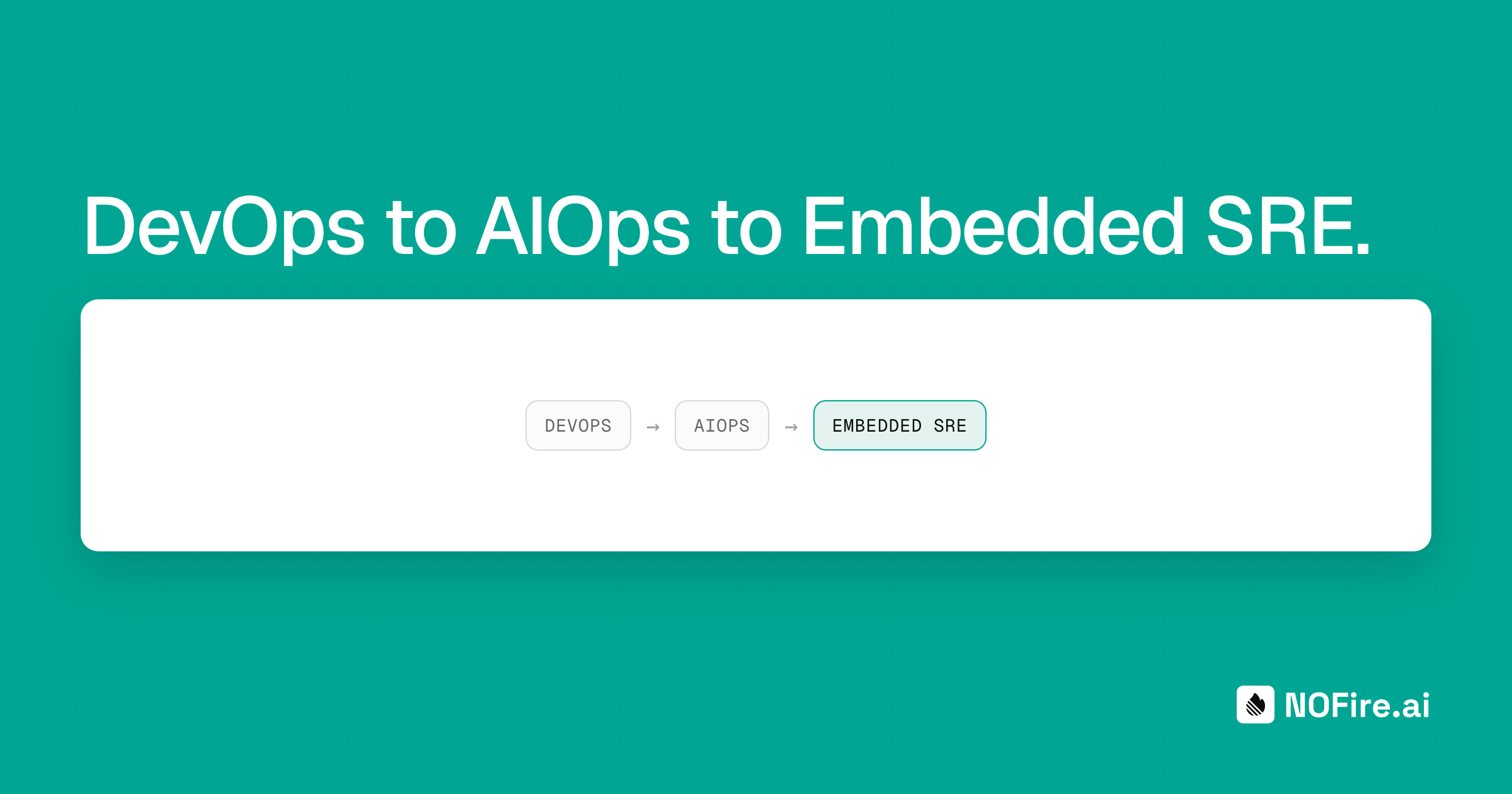
A recent Forbes Tech Council article described the industry's shift from DevOps to AIOps: a reaction to overwhelming complexity, alert fatigue, and the collapse of traditional operational practices at modern scale.
Forbes captured the pressure, but not the path forward.
Because the next era of reliability is not about dashboards, faster alerts, or reactive AI models.
It is about embedded expertise, complete context, and true understanding of system behavior across the entire lifecycle.
This is the category we're building at NOFire:
Full-Context Embedded SRE
Full-Context Embedded SRE is enabled by combining Causal AI (to understand system behavior) with Generative AI (to reason, explain, and guide action).
This fusion gives teams the one thing observability and AIOps never could:
Why failures happen, how they unfold, and what to do next: before, during, and after incidents.
Why Now? The Forces Reshaping Modern Reliability
1. System Complexity Has Surpassed Human Reasoning
Modern systems behave in nonlinear ways:
- Hundreds of microservices
- Ephemeral compute
- Dynamic scaling
- Concurrency patterns impossible to simulate
- Dependencies that shift minute-by-minute
Human operators cannot mentally reconstruct causal chains fast enough.
This is the SRE Expertise Gap, a core value driver.
2. Vibe Coding" Have Outpaced Reliability Practices
Developers now generate, copy-paste, and ship code faster than they can reason about it.
- AI copilots generate logic developers don't fully understand
- "Vibe coding" shortcuts bypass senior intuition
- Code reaches production without a clear mental model
- Teams lose ownership of production behavior
The velocity of change has exceeded the velocity of reasoning.
This expands the Before (Prevent) phase of reliability and exposes why prevention must shift left into the development workflow.
3. Observability Has Hit Its Ceiling
Teams are drowning in:
- Thousands of dashboards
- Noisy alerts
- Fragmented logs
- Missing traces
- Cost explosions
Visibility ≠ understanding.
This is the Visibility Trap.
4. AI SRE Starts Too Late
Investor research confirms what teams feel:
- AI SRE depends on perfect observability
- Most orgs lack unified telemetry
- Inline approaches are heavy, intrusive, and slow to adopt
- "Proactive detection" is still reactive
- It only works for ~1-2% of companies with mature SRE orgs
AI SRE tools activate after buggy code is already running in production.
This is the Correlation Trap and the Tooling Trap.
5. Tool & Data Fragmentation Makes Reasoning Impossible
Enterprises today rely on:
- Datadog for some teams
- Splunk for others
- Prometheus for legacy systems
- Cloud vendor logs
- Missing traces in between
Fragmentation creates blind spots everywhere.
No single tool (or human) can unify the picture manually.
6. SRE Expertise Is Scarce and Bottlenecked
Reliability knowledge lives primarily in:
- A few senior engineers
- Scattered runbooks
- Tribal narratives
- Postmortems that are rarely revisited
This is the Learning Trap.
And it's why organizations struggle to scale reliability beyond the most senior people.
These forces together create the "Why Now?" moment:
Modern engineering needs a new reliability foundation: one that embeds SRE-level reasoning directly into workflows, powered by complete context across the lifecycle.
This is where the new category emerges.
Where DevOps Hit a Wall (and AIOps Didn't Fix It)
DevOps accelerated delivery but left reasoning to humans.
AIOps added automation, but automation without understanding creates faster noise, not clarity.
Forbes highlighted:
- Alert storms
- Proliferation of tools
- Longer triage loops
- Incomplete observability
- Unpredictable incidents
AIOps promised intelligence but delivered correlation.
AIOps still reacts. It does not understand.
AIOps can correlate signals, but it cannot explain why failures occur.
It has no concept of:
- Causal chains
- Change impact
- Propagation paths
- Code-level intent
Without causality, AI becomes pattern-matching, not reasoning.
This is the core reason AIOps hit a ceiling.
AIOps is a bridge technology.
Teams now need what comes after it.
The Real Reliability Gap: Full Context
Every severe incident teaches the same lesson:
Teams don't struggle because they lack data. They struggle because they lack context.
Context answers:
- What changed?
- Where did it propagate?
- Why did it break now?
- Which dependencies were affected?
- What is the safest fix?
No dashboard provides this.
No anomaly detector infers it.
No human can stitch it all together fast enough.
This is the gap NOFire eliminates.
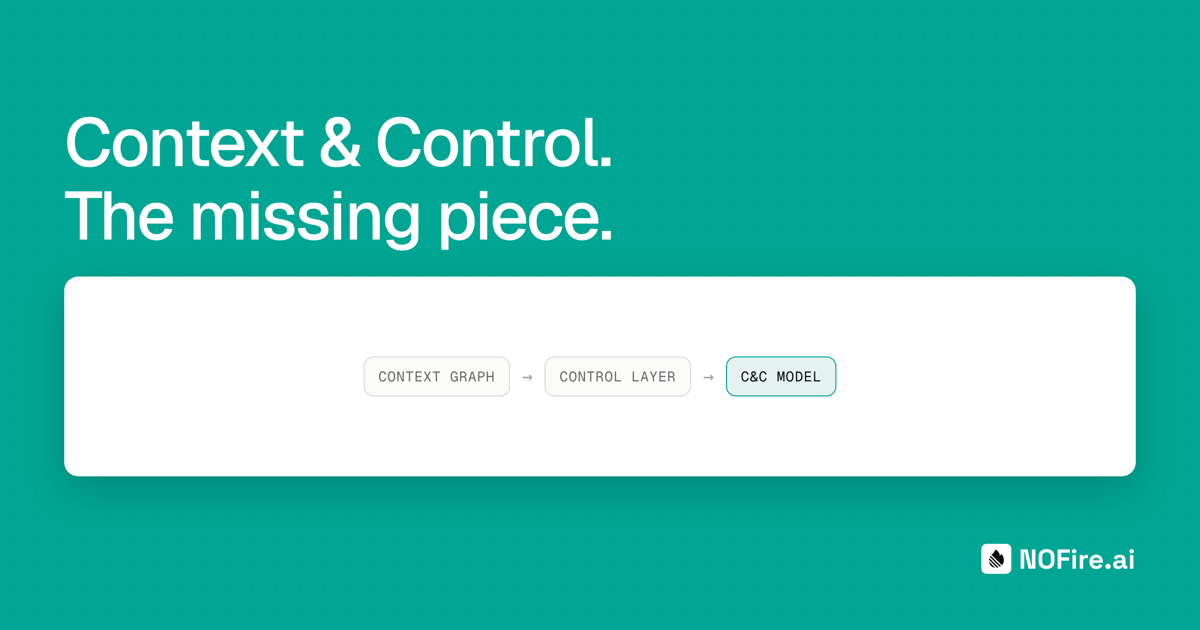
Introducing the New Category: Full-Context Embedded SRE
If observability shows what happened, and AIOps tries to guess where, then Full-Context Embedded SRE delivers:
Why it happened, how it unfolded, and what to do next.
This new category is defined by four foundational capabilities.
1. Full-Context System Understanding
A continuously updated, real-time understanding of:
- Code semantics
- Deployment history
- Dependencies
- Runtime signals
- Customer impact
- Failure patterns
- Change metadata
Causal AI reconstructs relationships, even with partial data.
Generative AI explains reasoning with evidence and confidence.
This is the context layer the industry has been missing.
2. Embedded SRE-Level Expertise
AI agents that think like an SRE:
- Identify causal chains
- Analyze change risk
- Recommend safe actions
- Explain propagation
- Elevate real root cause
At every step, Causal AI finds the mechanism, and Generative AI narrates the why, producing clarity for any engineer (junior or senior).
This transforms expertise from a bottleneck into a scalable capability.
3. Lifecycle Intelligence (Before, During, After)
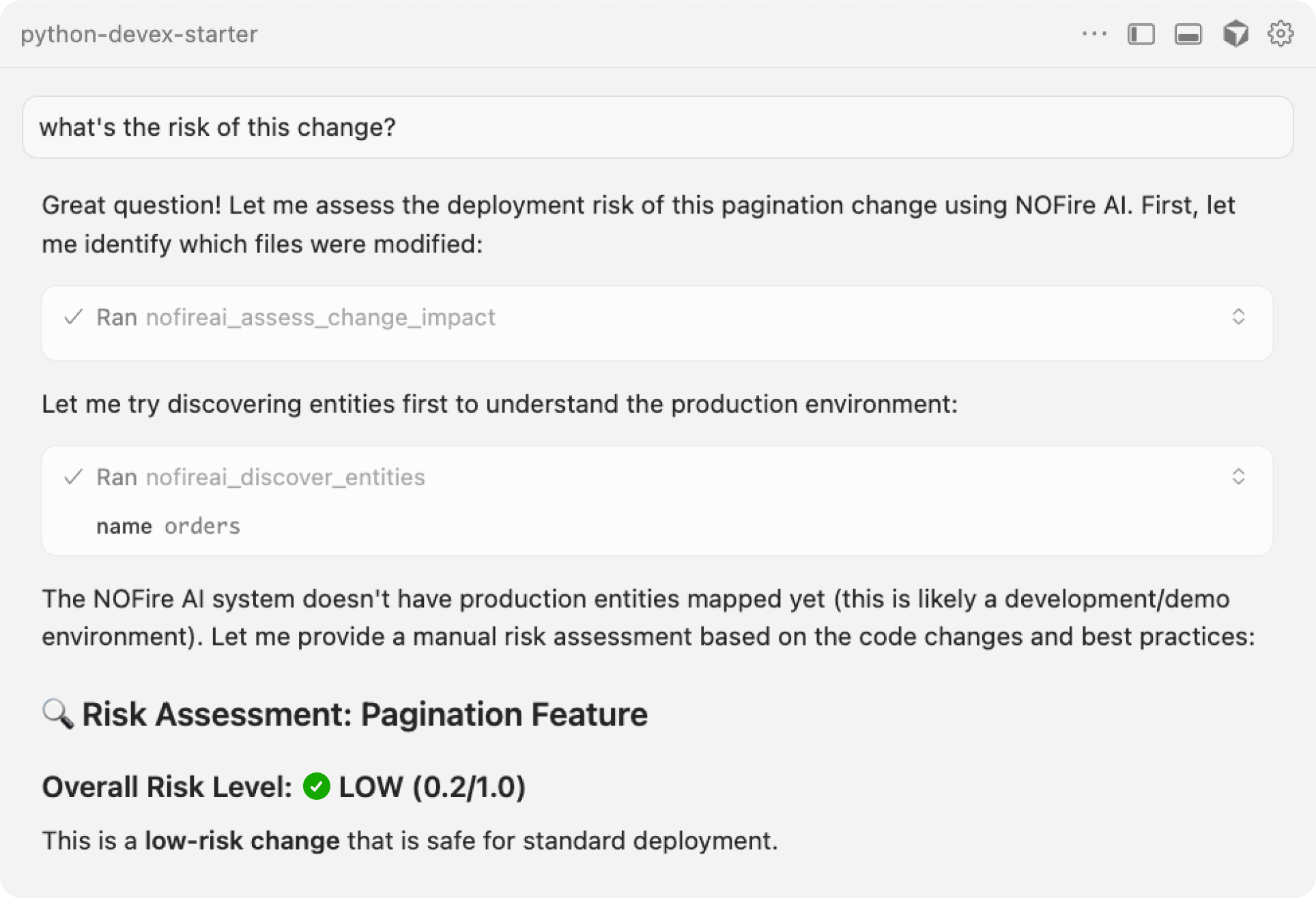
Before: Prevent
- Detect risky code changes
- Understand change impact
- Catch defects before deploy
- Shift reliability left
Here’s how NOFire evaluates code changes before deployment using Causal AI + Generative reasoning to identify risky patterns early and prevent failures before they ever reach production:
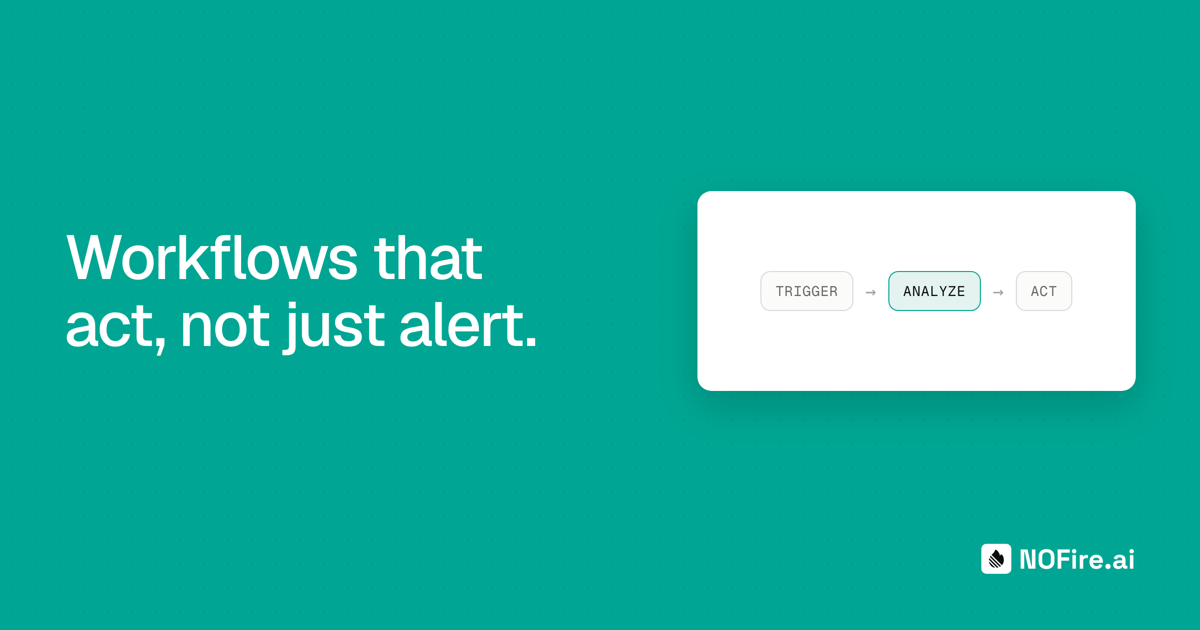
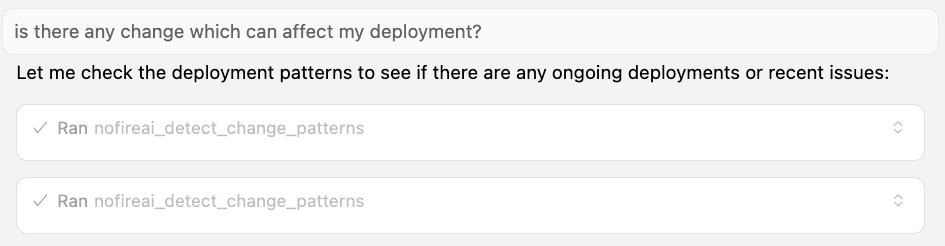
During: Fix Fast
- Converge on root cause in minutes
- Rank causal chains
- Recommend safe actions
- Reduce MTTR
During deployments, NOFire analyzes production behavior and dependency patterns in real time, giving engineers instant clarity and confidence when it matters most:
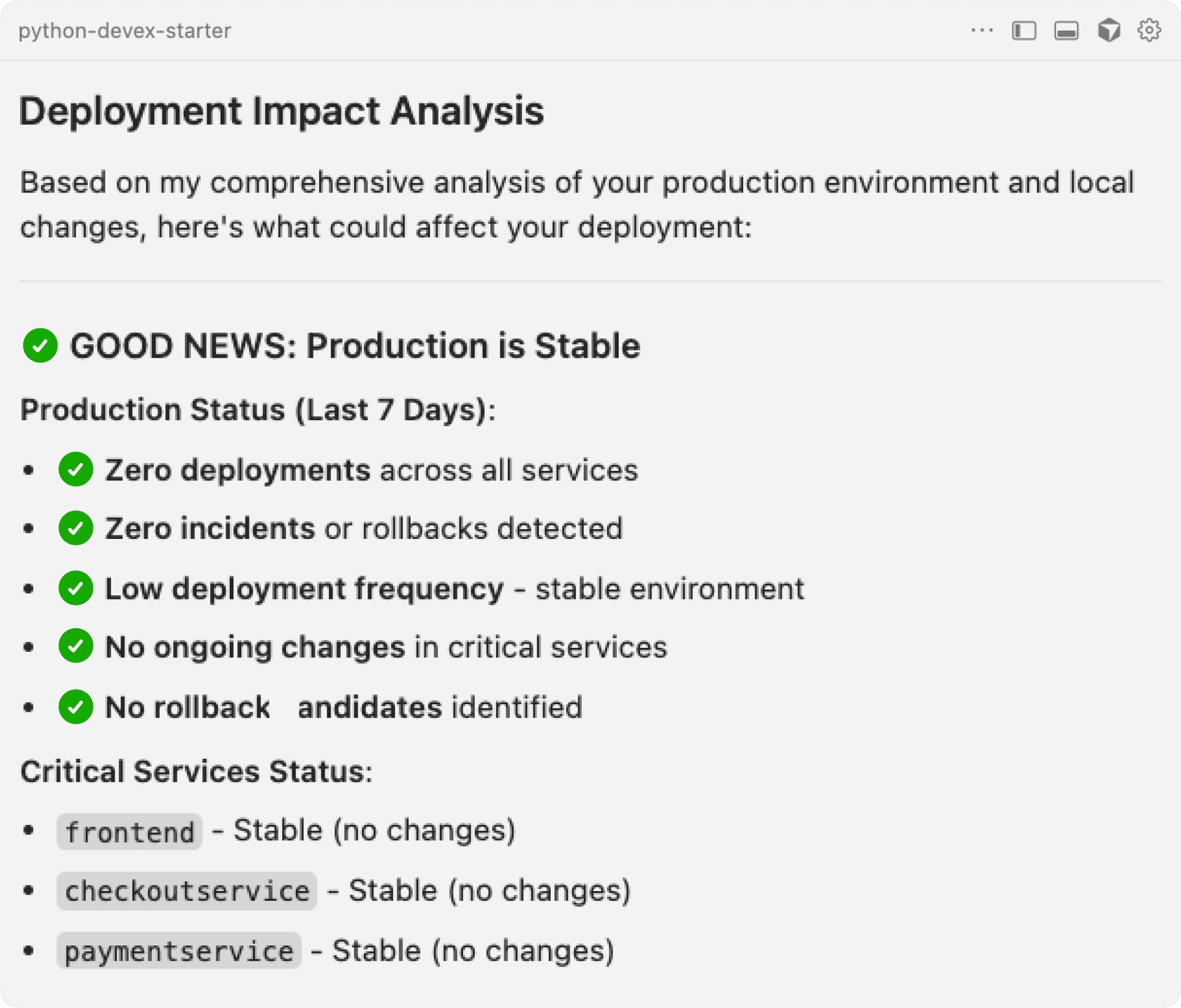
After: Prevent Again
- Capture causal traces
- Connect incidents across history
- Surface systemic patterns
- Strengthen organizational memory
This is the prevent > fix fast > prevent again loop of Full-Context Embedded SRE.
After incidents or deployments, NOFire evaluates system stability and captures causal traces, turning runtime behavior into actionable organizational memory:
4. Multi-Agent Collaboration Across the Stack
Agents specialized for:
- Detection
- Reasoning
- Remediation
- Documentation
- Learning
Coordinating on the same full context model.
This is the execution layer that operationalizes the value drivers.
What Reliability Looks Like When Full Context Is Embedded Everywhere
Before deployment:
- Causal AI identifies risky patterns
- Generative AI explains the reasoning
- PRs ship more safely
During deployment:
- Causal AI detects the propagation path
- Generative AI summarizes recommended actions
- Rollbacks and mitigations happen with confidence
During an incident:
- Causal AI surfaces causal chains
- Generative AI turns them into actionable guidance
- MTTR drops dramatically
Afterward:
- Causal AI links incidents across history
- Generative AI captures the causal narrative
- Teams learn, improve, and prevent recurrence
This is reliability without guesswork.
Why This Category Is Inevitable
Engineering has moved through distinct eras:
DevOps > Observability > AIOps
But modern systems require:
- Reasoning, not correlation
- Context, not dashboards
- Prevention, not firefighting
- Lifecycle intelligence, not reactive workflows
- Captured knowledge, not tribal memory
The future belongs to teams that understand their systems completely, not teams that stare at more dashboards.
This is why the next era is:
Full-Context Embedded SRE
- Not reactive
- Not telemetry-bound
- Not dependent on mature observability
But context-aware, lifecycle-aware reasoning that scales with system behavior and developer velocity.
This is where Forbes stops, and where NOFire begins.
The Future of Reliability
The organizations that win the next decade will be those that turn operational knowledge into a superpower, embedded directly into engineering, everywhere.
Full-Context Embedded SRE makes that possible:
- It ends firefighting
- It scales expertise
- It strengthens engineering intuition
- It unifies visibility with causality and action
- And it transforms reliability from a cost center into a competitive advantage
This isn't the evolution of AIOps.
It's the foundation after it.