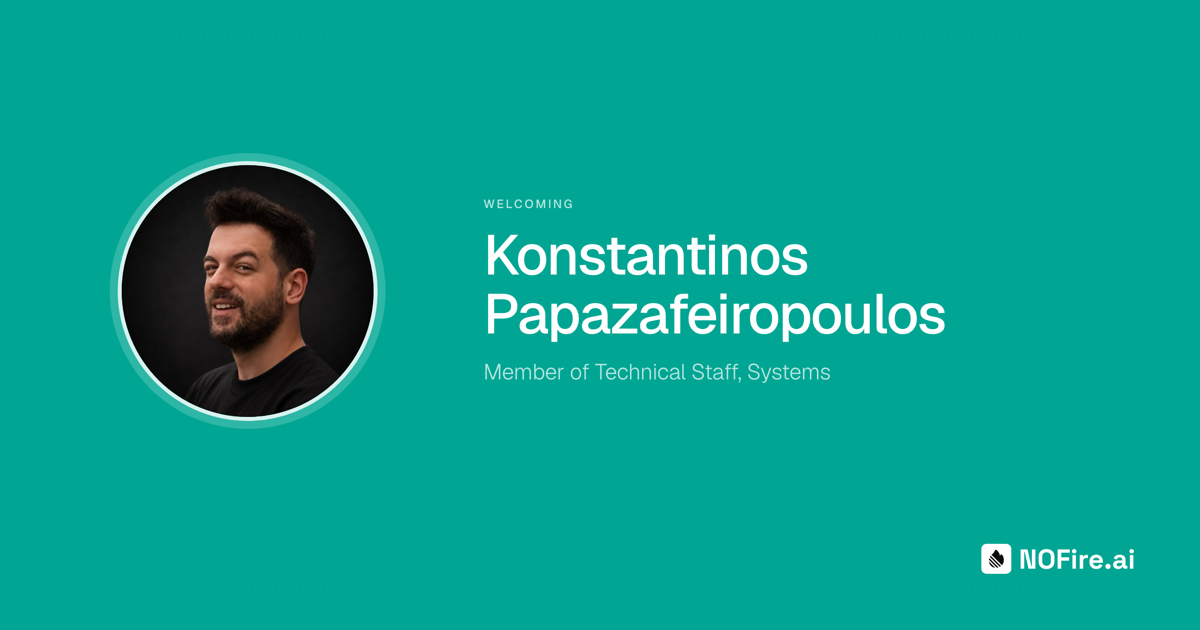
Konstantinos "Kostis" Papazafeiropoulos is joining NOFire AI as Member of Technical Staff, Systems.
The hard boundary around an agent action is only useful if your team keeps it on. Strong isolation that costs too much in latency gets turned off when the pressure is on. That is the trade-off engineering teams make in practice: isolation or speed. Kostis's work is what removes that choice.
He leads vAccel, a framework that exposes hardware accelerators to workloads running inside microVMs and unikernels. When an agent executes inside an isolated microVM, it normally cannot reach a GPU or an AI inference accelerator. That boundary blocks it. vAccel solves that with a portable, runtime-agnostic API that preserves the isolation contract while giving the workload full access to hardware, at a measured overhead of roughly 5% for ML inference compared to native execution. Teams do not have to choose between a boundary that holds and an agent that runs at production speed. Alongside urunc, vAccel forms the execution substrate the Context and Control Model depends on.
Background
Kostis builds runtime systems at the intersection of hardware acceleration and secure containerization. He trained as an Electrical and Computer Engineer, and his work sits on the layer between hardware and the workloads that run on top of it, specifically on how to preserve performance when strong isolation is required. His expertise spans OS internals, QEMU/KVM, unikernels, memory management, isolation primitives, and resource elasticity. His earliest systems work has academic roots, including GPU remoting over sockets (gpusockets), an early take on decoupling a workload from the accelerator it runs against, a theme that runs through everything he has built since.
Before NOFire AI, Kostis worked at Nubificus LTD, where he led vAccel and built much of the surrounding acceleration and isolation stack.
Open-source contributions
vAccel is the throughline. Kostis bootstrapped it from scratch, taking it from the initial design through to a fully-fledged open-source project with extensive CI, a modular set of acceleration backends, and a diverse range of frontends spanning IoT devices, Linux guests, and remote Linux hosts. The point of that architecture is portability: the same acceleration API holds whether the workload runs on a constrained edge board or talks to a remote host over the network.
Around that core, his contributions span the full virtualization-to-hardware path:
- Thread-local storage (TLS) support for rumprun-aarch64. Porting the Rumprun unikernel to ARM64, including the low-level TLS plumbing needed to run real applications.
- Container encryption. Protecting workload images and data along the secure-containerization axis of his work.
- virtio-accel. A Linux kernel module implementing a VirtIO-based transport for acceleration operations, the guest-to-host channel that makes vAccel's isolation-preserving design work.
He also contributes upstream across the cloud-native runtime ecosystem. Recent examples include adding TCP socket support to containerd's ttrpc-rust and a sync-client crash fix in the same project, updating filesystem ops in dragonflyoss/nydus, and bumping ttrpc in the Kata Containers runtime, the kind of plumbing work that keeps the broader sandboxed-runtime stack healthy.
More about Konstantinos
How did you get into systems work?
I trained as an Electrical and Computer Engineer, and I was always drawn to the layer where software meets hardware. My early research was on GPU remoting, getting a workload to use an accelerator that lived somewhere else entirely. That question, how you keep a workload fast when it cannot touch the hardware directly, is more or less what I have been working on ever since. The deeper you go into OS internals and virtualization, the more you realize most of the interesting problems live in that gap.
Why NOFire AI?
Because the problem is the one I find hardest and most worth solving: keeping a strong boundary around a workload without paying for it in performance. Agents make that tension sharper than ever. NOFire is building the boundary that teams actually keep on, and that is exactly where my background in isolation and hardware acceleration is useful. It felt like the natural next step rather than a change of direction.
What will you be working on here?
Out-of-band VM introspection: understanding what a workload is really doing by observing it from outside the VM boundary, and closing the semantic gap between low-level operations and what they mean at the application level. The goal is to see and reason about agent behavior without weakening the isolation that makes the observation trustworthy in the first place. vAccel and urunc are the substrate that work sits on. And as agents start running local LLMs instead of calling a remote API, the pressure for fast on-host acceleration inside the sandbox is going to hit hard, and that is exactly where vAccel comes to the rescue.
Tools you rely on?
QEMU/KVM and Firecracker, the Linux kernel and its tracing and debugging tooling, C and increasingly Rust, gdb, and a CI setup I trust enough to let it catch my mistakes. And a terminal, mostly.
Outside of work?
I listen to a lot of music, across more genres than I could sensibly defend. It is the constant in the background while everything else changes.
Kostis is based in Greece. You can follow his work on GitHub.