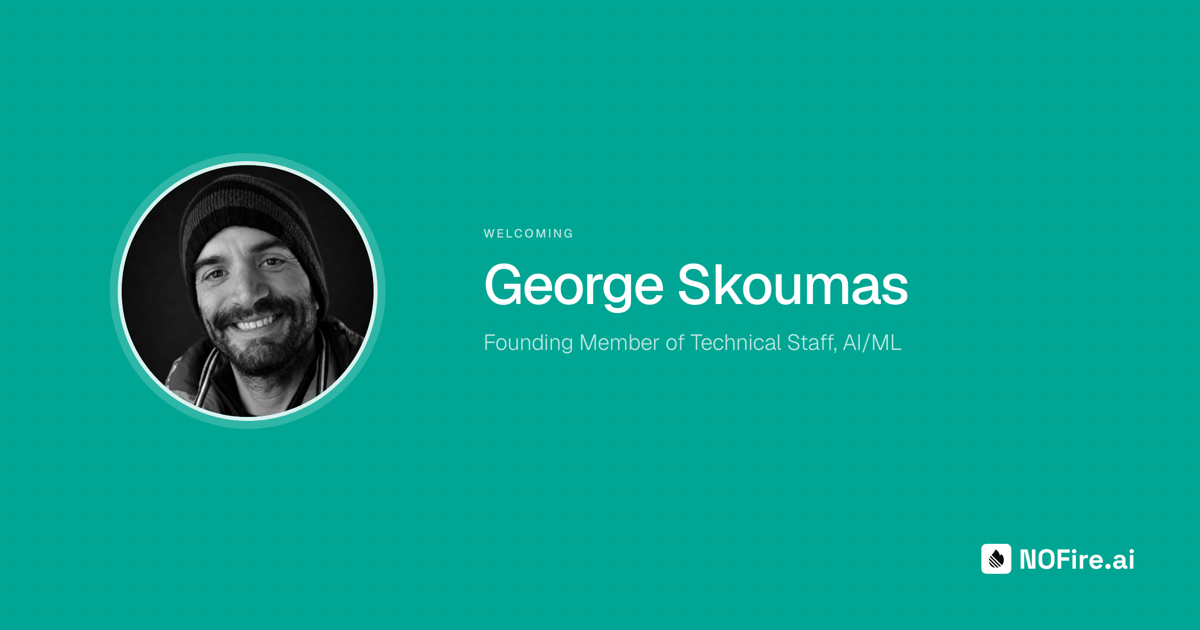
George Skoumas is joining NOFire AI as Founding Member of Technical Staff, AI/ML. He comes from TileDB, where he worked on integrating multi-dimensional array storage with TensorFlow and PyTorch for high-performance deep learning I/O, from Panther, where he worked on integrating security event pipelines with Snowflake, and from Beat (Daimler/BMW Group), where he worked on the algorithmic design of a real-time pricing platform. Most recently he has been working on NLP systems for converting unstructured documents into structured, actionable representations. He brings all of it to a problem that sits at the core of the Context and Control Model: making sure agents reason from the right context.
The "Context" in the Context and Control Model is not a design detail. It is the hardest engineering problem in the system. A model that receives the wrong context does not fail loudly. It reasons confidently from bad premises and produces answers that look correct. For a production AI system, that failure mode is worse than no answer at all.
George has been working on that problem rigorously, with benchmarks to show for it.
Background
At TileDB, George focused on integrating multi-dimensional array storage with TensorFlow and PyTorch, optimizing the I/O path for training deep learning models at scale. Working at that interface between storage and learning builds an intuition for how data structure shapes what a downstream system can reason about, an insight that runs directly through his context work.
Before TileDB, he spent time at Panther integrating security event pipelines with Snowflake. The stint was brief, but the exposure to how structured signals feed downstream analysis reinforced the same instincts.
Earlier, at Beat (Daimler/BMW Group), he worked on the algorithmic design and implementation of a real-time pricing platform. Shipping pricing ML under production load is where his intuition for reliability and scale in ML systems was formed.
Most recently, he has worked on NLP systems that turn unstructured documents into structured, actionable representations. That discipline, taking raw signals, text, logs, incident notes, and converting them into something a model can reason over precisely, is where context engineering starts.
Deterministic context selection
George approaches context quality as a systems problem with measurable outcomes, not a prompting heuristic.
He has run benchmarks on LongBench v1 (Claude Sonnet 4.5, n=200 per dataset, QA F1 score) to evaluate deterministic context selection against naive full-document retrieval. The results are counterintuitive: at 50-60% token budget, structured context selection matches or exceeds full-document performance. On HotpotQA (multi-hop QA with distractors), the approach scores 67-69 F1 at 50-60% budget, against a full-document baseline of 66.26. On Qasper (dense academic papers), it reaches 97% of full-document F1 at half the tokens.
The practical implication: the problem is not that agents need more context. It is that they need the right context. More tokens do not help when the signal is buried in noise. Structured selection, with a context hint to orient retrieval, lifts F1 by 10-15 points at every budget level compared to random chunk selection at the same budget.
This is the work that matters at NOFire AI. The context graph that feeds every agent action has to assemble the right facts under incident pressure, at production scale, where the relevant signals are sparse inside a large and noisy observation stream. George has benchmarked exactly that trade-off and knows how to build the pipeline that makes it correct.
More about George
How did you get into context selection as a discipline?
It came out of NLP work. Once you spend enough time turning unstructured documents into representations a model can actually use, you start to see that the bottleneck is rarely the model. It is what you put in front of it. From there, treating context as something you select deliberately, and then measure, was a natural step.
Why NOFire AI?
The Context and Control Model frames the problem the way I already think about it. Most systems fail quietly because they reason from the wrong premises, not because the model is weak. NOFire AI is building around that failure mode directly, which is rare, and the timing to work on it here is good.
What will you be working on here?
The context graph, mostly. Making sure the facts that feed each agent action are the right ones under incident pressure, where the useful signal is sparse and the surrounding noise is large. Concretely that means the selection and retrieval pipeline, and holding it to benchmarks rather than intuition.
Tools you rely on?
Claude Code for most of the day now. Python underneath it. And books when I need to actually think, the paper kind.
Outside of work?
A fair amount of time outside. I also keep a running side interest in context optimization that predates this role, which you can see at high-snr.com.
George is based in Greece. You can follow his work on LinkedIn.