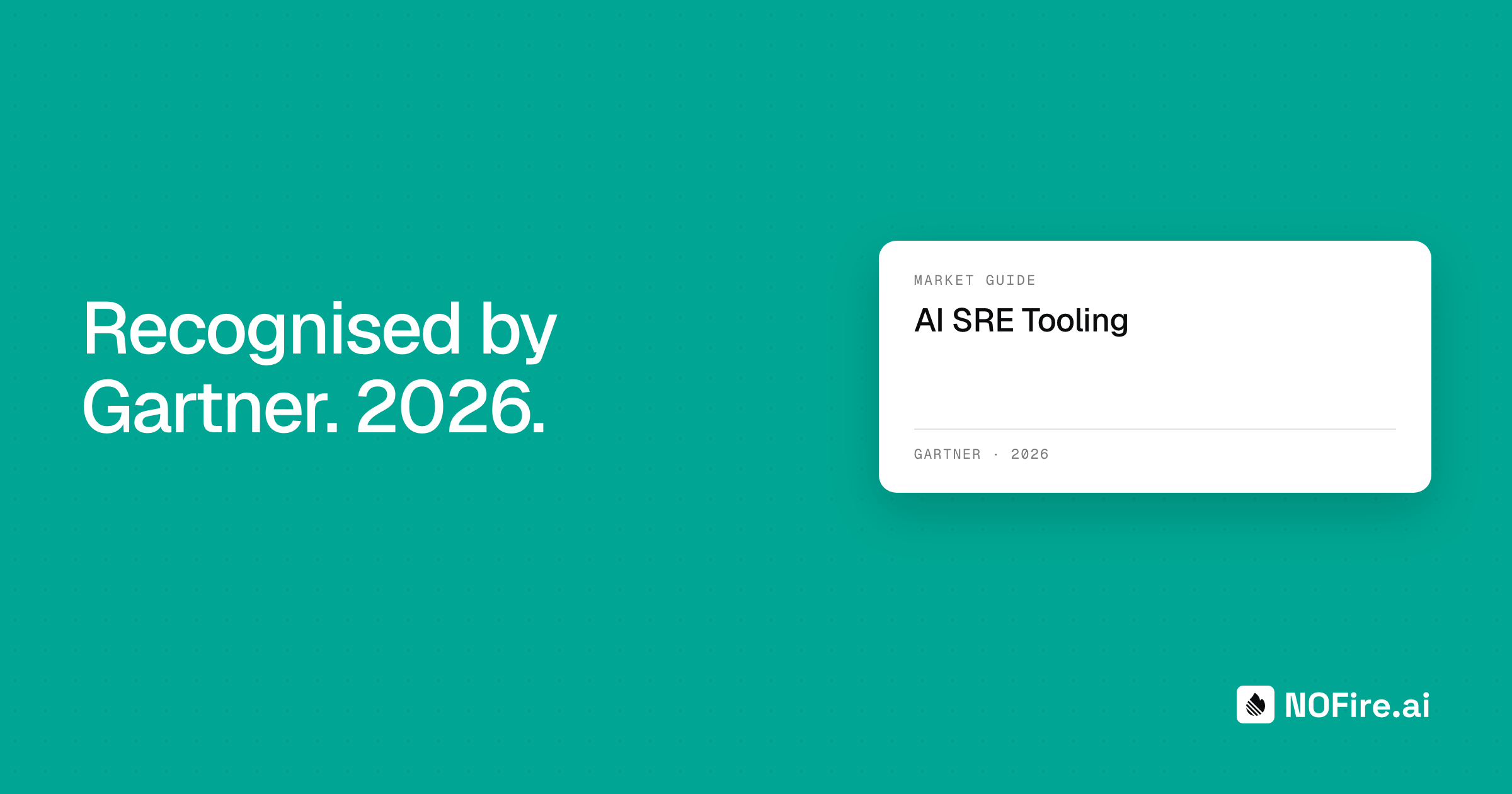
In 2026, Gartner published its first Market Guide for AI Site Reliability Engineering Tooling. NOFire is recognised as a Representative Vendor.
We want to be straightforward about what that means. A Market Guide is not a ranking. Gartner is not endorsing us. What it is: independent research that maps an emerging category, identifies the core problem vendors are trying to solve, and describes where the market is headed. Being named in it means Gartner sees our work as relevant to that conversation.
Here is what the guide says and why we think it matters.
The problem Gartner identified
The guide opens with a clear diagnosis: traditional SRE and operations teams cannot keep pace with the technology and operational demands required to deliver effective reliability outcomes. The math does not work at scale.
Specialized SRE talent is expensive and scarce. Training internal teams takes months. Modern distributed systems produce more telemetry, more alerts, and more interdependencies than any team can reason over manually. The result is alert fatigue, slower incident resolution, and reliability practices that stay confined to teams large enough to afford them.
Gartner's projected adoption curve reflects how acute the gap has become: less than 5% of enterprises use AI SRE tooling today. By 2029, Gartner expects that number to reach 85%.
That is not gradual adoption. That is a shift driven by necessity.
The finding that matters most
The guide identifies a critical limitation with the current wave of AI SRE tooling:
"Organizations that select AI SRE tooling focused on operations only will become better at reactively fixing incidents but not at improving system reliability."
This is the finding we have been building around since day one.
Most tools in this space are optimized for incident response: faster triage, automated root cause correlation, reduced MTTR. Those capabilities matter. But they are downstream of the real problem. By the time you are investigating an incident, the failure has already reached production. You are measuring how quickly you clean it up, not whether it needed to happen.
The question that actually changes reliability outcomes is earlier: what did we know before this deployed? What did we know about the change, the system it was entering, the dependencies it touched, the patterns this has broken before?
Gartner's roadmap reflects this. By 2029, the report predicts 75% of organizations will integrate AI-distilled SRE lessons into product design and delivery, up from 10% today. By 2030, 60% of new infrastructure designs will be validated by AI using historical failure data before development begins. The work is moving left.
How we think about this
NOFire is built on a Production Context Graph: a continuously evolving, time-versioned model of how your services, dependencies, changes, and past failures connect.
That graph is what makes the before-and-after distinction real rather than aspirational.
Before a change deploys, the graph surfaces blast radius: which services are downstream, whether similar changes have caused incidents, whether the dependencies involved have recent instability. Engineers get that context at the PR, not after the alert fires.
After something breaks, the graph connects symptoms to causes across the full change history: which deployment, which commit, which configuration drift, in what order. Root cause in minutes rather than hours, because the causal chain is already mapped.
And across time, every investigation feeds back into the graph. The system learns which change patterns are risky, which services are fragile, which runbooks actually resolved what. That learning compounds. The team gets faster at both preventing failures and resolving the ones that get through.
Gartner's roadmap describes where the market is going. It is the foundation we started building from.
What this recognition means to us
The Gartner finding matters to us not because of the recognition. It matters because an independent analyst firm looked at this market and reached the same conclusion we did: reactive tools are not enough, and the work has to happen earlier.
We built NOFire to make that shift real. Not as a strategic bet, but because the alternative is watching good engineers spend their careers fighting fires that had clear signals beforehand.
This confirms the direction. The rest is execution.
Read the guide
Gartner's Market Guide for AI Site Reliability Engineering Tooling covers the market problem in detail, identifies core capabilities to evaluate, and maps the roadmap of what proactive AI SRE tooling will look like over the next five years.
You can download the full report here: Get the Gartner Market Guide
Gartner, Market Guide for AI Site Reliability Engineering Tooling, Daniel Betts, Chris Saunderson, Hassan Ennaciri, 26 January 2026.
Gartner is a trademark of Gartner, Inc. and/or its affiliates. Gartner does not endorse any company, vendor, product or service depicted in its publications, and does not advise technology users to select only those vendors with the highest ratings or other designation. Gartner publications consist of the opinions of Gartner's business and technology insights organization and should not be construed as statements of fact. Gartner disclaims all warranties, expressed or implied, with respect to this publication, including any warranties of merchantability or fitness for a particular purpose.