Every hero reaches the moment when the old world becomes unlivable. A point of such clarity, or such pain, that staying the same is no longer an option. For you, that moment came quietly. Not during the worst outage. Not during the war room. Not even during the dreaded board postmortem. It came after.
When the dashboards settled. When the alerts stopped. When the teams dispersed. When the report was written. When the executives nodded. When operations “returned to normal.”
And you saw the truth: This will happen again.
Not because people failed. Not because tools malfunctioned. Not because processes were weak. But because production behavior is no longer legible to humans alone and no amount of human effort can change that. That realization is the spark. The inflection point. The call to seek a better way.
A Subtle Pattern Hidden Beneath the Chaos
You began to see a pattern across incidents:
Failures were not random.
They followed behaviours.
Behaviours were not isolated.
They were connected across services.
Signals were not independent.
They were symptoms of deeper, invisible interactions.
Incidents were not surprises.
They left faint traces before they unfolded but nothing in your tool stack could connect them into a coherent picture. You started noticing:
- Small deviations in latency before cascading failures
- Queues backing up before customer-visible impact
- ML inference drift preceding incorrect outputs
- Kubernetes autoscaling “micro-stutters” before node starvation - Feature flag rollouts subtly reshaping behaviour
- A single config change amplifying load across multiple services ● Cloud anomalies flattening entire environments
These were shadows of upcoming failures, early-stage behaviours that only make sense in hindsight. That’s when the question emerged:
“If these signals were visible after the incident… were they visible before it?”
The answer, you suspected, was yes. But the tools you had were not built to interpret them. They were not built to understand behaviour. They were not built to warn you before the tipping point. This is the call to transformation:
“What if we could see risk before change becomes irreversible?”
“What if reliability shifted earlier in the lifecycle?”
“What if systems produced explanations instead of raw signals?”
For the first time, you allowed yourself to imagine it.
The Search for Prevention
The idea wasn’t new prevention has always been the dream. But every attempt to achieve it had fallen short:
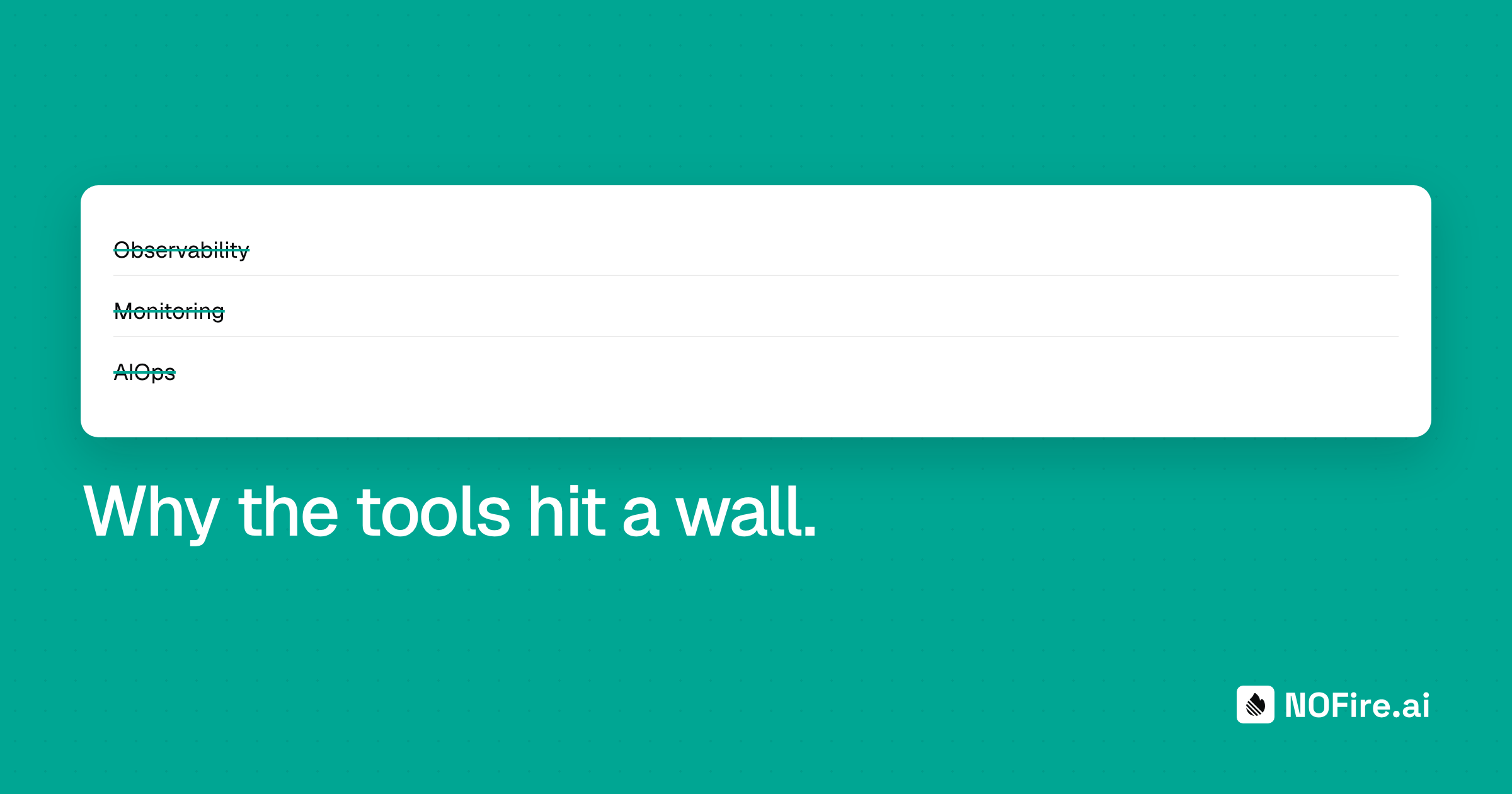
Observability
Gives visibility, not foresight.
Monitoring
Gives thresholds, not understanding.
AIOps
Correlates symptoms, doesn’t explain causes.
Automation
Acts fast, but only after something breaks.
Predictive analytics
Focuses on surface metrics, not underlying behaviour.
Chaos engineering
Explores scenarios, but doesn’t map real-world behavioural drift.
CMDBs and dependency maps
Show topology, but not dynamic interactions.
RCA
Explains what happened, not how to prevent it.
None of these connected behaviour, causality, and lifecycle. None of them united code changes, infra behaviours, platform dynamics, and service interactions into a single, evolving model of how the system actually works. You realised prevention requires more than data. It requires a system that can:
- map how services actually interact
- track how change propagates over time
- preserve the causes and outcomes of past failures
- explain conclusions with evidence
- surface risk before deploy, not after impact
This is beyond what humans can do at scale. It is beyond what observability tools were designed for. It is beyond what AIOps algorithms can correlate. This is the point in the journey where the hero realizes:
“We need a new kind of capability, something we’ve never had before.”
The Limits of Human-Centric Operations
You began to see more clearly the profound mismatch between system complexity and human cognition. Humans are extraordinary at intuition, creativity, and engineering. But humans cannot:
- Track millions of signals
- Interpret dynamic behaviours across 200 microservices
- Model cloud orchestration logic
- Detect emerging AI inference drift before customer impact
- Reason about emergent event-driven interactions
- Hold multidimensional causal graphs in their minds
Your teams weren’t failing. They were overmatched. The system evolved, but your operational model did not. This is where every hero confronts the truth:
“The world has changed. The tools have not. We must evolve or the system will break us.”
The Growing Pressure From Above
Forward-thinking executives began asking a new kind of question:
- “How do we prevent failures, not just detect them?”
- “What can we do to reduce incident frequency by half?”
- “Why can’t we see emerging risks earlier?”
- “What will the regulator say about unknown dependencies?”
- “How do we become resilient, not just observant?”
You felt the urgency rising:
- New regulations demanding resilience evidence
- Boards demanding predictable reliability
- Customers demanding uninterrupted experiences
- Product teams demanding faster releases
- Architecture teams demanding clarity
- Platform teams demanding stability
The pressure was mounting. The margin for error was narrowing. The expectations were accelerating. Your mandate had shifted from:
“Fix incidents quickly” to
“Prevent incidents early.”
And yet no existing tool could deliver that outcome.
The Growing Pressure From Below
Your teams felt the strain:
- On-call burnout
- Alert fatigue
- Fragmented context
- Blame across teams
- Fatigue from repeated incidents
- The psychic weight of uncertainty
- The cognitive overload of operating blind
They were not just asking for better dashboards. They were asking for:
- Understanding
- Clarity
- Predictive insight
- Less noise
- More trust in the system
- Fewer emergencies
- More time to build instead of fix
The team’s plea echoed the executive mandate:
“We can’t keep doing this. We need a new model.”
The Early Signs of a New Paradigm
You noticed that transformative reliability wasn’t coming from:
- more dashboards
- more telemetry
- more automation
- more alerts
- more runbooks
- more tools
Instead, it was emerging from a small but powerful shift:
Understanding behaviour, not just observing signals.
Failures began in behaviour:
- Drift
- Degradation
- Anomalies
- Interactions
- Cascades
- Dependencies
You realised:
If we can model behavior, we can expose risk earlier. If we can expose risk before deploy, we can prevent avoidable failures.
This became your guiding insight. Your turning point.
Your “call to adventure.”
A new category was needed one that didn’t just react to failures or surface signals, but reasoned about how systems behave over time.